
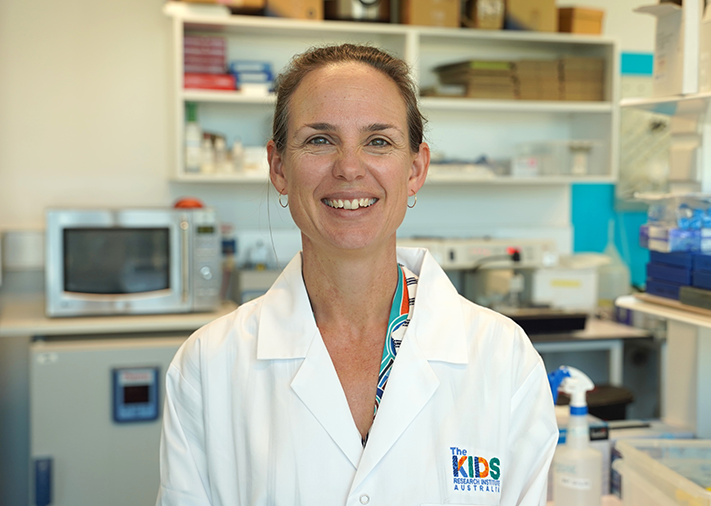
Meegan Howlett
Head, Cancer Preclinical Core
BSc(Hons), PhD
meegan.howlett@thekids.org.au
Dr Meegan Howlett is a translational cancer researcher and Head of the Cancer Preclinical Core Team at The Kids Research Institute Australia.
With more than 15 years of experience in cancer research, Dr Howlett has developed extensive expertise in preclinical cancer modelling, translational drug development and the evaluation of novel therapies for childhood cancers. Her work focuses on bridging the gap between laboratory discovery and clinical application, ensuring promising new treatments are rigorously tested before progressing to clinical trials.
Before establishing the Cancer Preclinical Core Team, Dr Howlett was Senior Research Officer and Project Manager within the Brain Tumour Research team at The Kids, where she helped lead research aimed at improving outcomes for children with brain tumours. Her research has focused on mechanistic in vivo cancer modelling and translational drug discovery, using advanced preclinical systems including transgenic and patient-derived xenograft models, orthotopic transplantation approaches, and clinically relevant treatment platforms incorporating image-guided radiotherapy, chemotherapy, immunotherapy and novel targeted agents.
Having completed her PhD at the University of Melbourne and the Murdoch Children's Research Institute, before undertaking postdoctoral training in the Leukaemia Laboratory at The Kids, Dr Howlett has built a strong translational research track record spanning gastrointestinal cancer biology, haematological malignancies and paediatric brain tumour therapeutics.
Dr Howlett is passionate about facilitating impact-driven, team science by providing the support, tools and processes that enable talented researchers to thrive. Through collaboration and shared expertise, she is committed to accelerating the development of better treatments and improving outcomes for children with cancer.
Projects
Finding new, safer and targeted therapies for paediatric brain cancer that amplify responses to radiation therapy
Radiation therapy is an essential component of brain cancer treatment. However, the high doses currently required are extremely damaging to the growing brains and bodies of children.
Developing and characterising juvenile models of aggressive paediatric brain cancers for the evaluation of novel immunotherapies.
While profound treatment responses have been realised using immunotherapy for some cancer types, this is yet to be seen for paediatric brain cancer patients.
Published research
Establishing a Clinically Relevant Radiation Therapy Method for Preclinical Medulloblastoma Research
Craniospinal irradiation (CSI) is a cornerstone of pediatric brain cancer therapy, yet detailed, reproducible protocols for accurate CSI delivery in preclinical mouse models remain scarce, hindering translational research and the development of radiosensitizing strategies. We aimed to establish a clinically relevant, easily replicable radiation therapy protocol for medulloblastoma mouse models, providing a robust platform for preclinical evaluation of novel therapeutic combinations.
ONC201 in Combination with Paxalisib for the Treatment of H3K27-Altered Diffuse Midline Glioma
Diffuse midline gliomas (DMG), including diffuse intrinsic pontine gliomas (DIPG), are the most lethal of childhood cancers. Palliative radiotherapy is the only established treatment, with median patient survival of 9 to 11 months. ONC201 is a DRD2 antagonist and ClpP agonist that has shown preclinical and emerging clinical efficacy in DMG.
In vivo loss of tumorigenicity in a patient-derived orthotopic xenograft mouse model of ependymoma
Ependymomas (EPN) are the third most common malignant brain cancer in children. Treatment strategies for pediatric EPN have remained unchanged over recent decades, with 10-year survival rates stagnating at just 67% for children aged 0-14 years. Moreover, a proportion of patients who survive treatment often suffer long-term neurological side effects as a result of therapy. It is evident that there is a need for safer, more effective treatments for pediatric EPN patients.
Education and Qualifications
- 2005-2009 – PhD, The University of Melbourne, Paediatrics
- 2003 - Bachelor of Science with first class Honours, The University of Melbourne, Department of Medicine
- 2001 - Bachelor of Science (Biotechnology) Murdoch University, WA
Awards/Honours
- 2018 Friends of the Institute travel award, The Kids Research Institute Australia
- 2013 Springer scholarship award, CCN society, 7th International Workshop on the CCN family of genes, Nice, France.
- 2006 Award for best young investigator, oral presentation. Western Hospital, Victoria.
- 2004 Distinguished poster presentation, Digestive Diseases Week, New Orleans, LA, USA
- 2005-2008 – Melbourne Research Scholarship, Melbourne University, Vic, Aus
Active Collaborations
Dr Howlett worked closely with CIs Endersby and Gottardo to recently establish a national collaboration of leading research scientists and clinicians from 14 institutions/hospitals across Australia named PETRA: PrEclinical Translational Research Alliance for Paediatric Brain Cancer and have partnered with the cooperative clinical trials group Australian and New Zealand Children’s Haematology and Oncology Group (ANZCHOG) to facilitate translation.
Dr Howlett also collaborates locally with researchers from Sir Charles Gairdner Hospital (Ebert), Centre for Microscopy Characterisation and Analysis (Rosenow) and the Lion’s Eye Institute (Mehnert) utilising high-resolutions MRI to measure the side-effects of radiotherapy on the developing brain. Key International collaborations with colleagues in US (St Jude Children’s Research Hospital; Roussel) and Germany (DKFZ; Kool) are exemplified by publications.